Grappling Industries Rules: Complete BJJ Competitor Guide
Learn the key Grappling Industries rules for Gi and No‑Gi: legal techniques, uniform and hygiene requirements, weigh‑ins, scoring, and match times so you can focus on winning instead of worrying about disqualification.
Grappling Industries is a global Brazilian jiu‑jitsu and submission grappling organization that runs round‑robin format tournaments, giving competitors multiple matches per division instead of a single elimination bracket. Events are known for being well organized, beginner‑friendly, and popular with hobbyists and serious competitors alike.
To have a smooth experience on the day, every athlete should understand the core rules: which techniques are legal, what uniforms are allowed, how weigh‑ins work, and how points and penalties are handled. This guide walks through the essentials in a clear, easy‑to‑reference format.
Quick tip: Always check the latest PDF rulebook and your event page on Smoothcomp in case small details (like division names, age brackets, or allowances) have changed for your specific tournament.
Quick Navigation
Grappling Industries Allowed & Prohibited Techniques
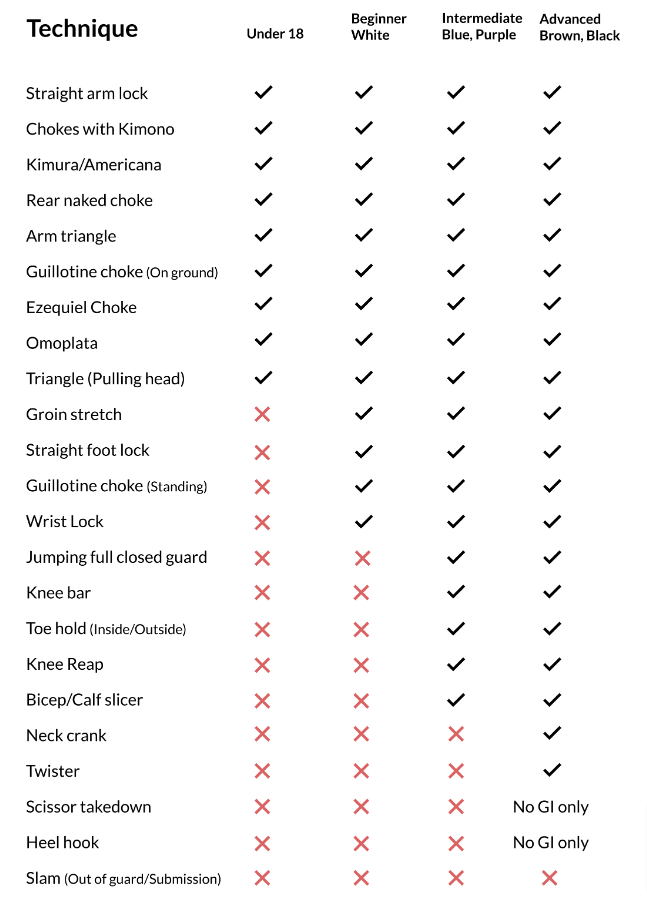
Grappling Industries adjusts legal and illegal techniques based on age and skill level to keep matches exciting but safe. Kids, teens, and lower‑level adults have more restrictions, while advanced and expert divisions allow a wider range of submissions, especially on the legs.
The promotion graphics and rule charts used by Grappling Industries clearly show which submissions (such as heel hooks, twisting leg locks, and neck cranks) are restricted at each belt level and in each rule set. Always confirm your division’s rules before competing so you do not rely on a technique that is illegal for your bracket.
 Safety‑First Ruleset
Varies by Age & Skill
Safety‑First Ruleset
Varies by Age & Skill
Key Principles for Legal Techniques
- Beginner and youth divisions ban dangerous twisting leg locks and spine‑twisting cranks, focusing instead on basic joint locks and positional control.
- Advanced and expert adult no‑gi divisions may allow more leg locks and reaping variations, but the exact rules are defined in the latest rulebook and event info.
- Slams to escape submissions or takedowns are prohibited, and actions that target the neck or spine in a uncontrolled way can result in disqualification.
Important: If you are unsure whether a specific entry (for example a reaping‑style leg entanglement or a neck crank from the back) is legal in your division, ask the event staff or review the most recent Grappling Industries PDF rules for that tournament before stepping on the mat.
Gi & No‑Gi Uniform Requirements
Your gi or no‑gi outfit must meet Grappling Industries’ basic safety and cleanliness standards. While the organization is more flexible than IBJJF about colors and patch placement, officials can still require you to change any uniform they consider unsafe or inappropriate.
Gi Requirements
- Gis are not pre‑measured, but staff can ask you to change gi if it is obviously too short, too long, overly patched in grip‑blocking areas, ripped, dirty, wet, or has a strong odor.
- Mixed gi colors (different color top and pants) are generally allowed, as long as the uniform looks professional and safe.
- Competitors may wear a tight‑fitting rash guard under the gi but are not allowed to wear a loose T‑shirt underneath.
- Belts must be properly tied and correspond to your rank; repeatedly losing your belt can result in brief match pauses to re‑tie it.
No‑Gi Requirements
- Board‑style shorts with no pockets, or with pockets fully stitched closed, are required; no exposed zippers, metal, or hard plastic is allowed.
- Shorts must at least cover mid‑thigh and cannot go higher than the knee; extremely short or overly baggy shorts can be refused.
- Spats or compression tights may be worn under shorts if you prefer more coverage.
- A tight‑fitting rash guard or elastic compression shirt is mandatory—no shirtless competitors and no loose tops.
- All competitors must wear undergarments under their kit; groin protectors, jewelry, and hard braces are not allowed.
Related: If you are also competing in IBJJF events, check out a detailed comparison of IBJJF Gi and No‑Gi uniform rules to see where they differ from Grappling Industries.
Hygiene & Safety Requirements
Grappling Industries enforces simple but strict hygiene rules to reduce the risk of skin infections, mat damage, and unpleasant experiences for other competitors.
- Fingernails and toenails must be kept short and neatly trimmed to prevent cuts and scratches.
- Long hair should be tied back or braided so it does not interfere with the opponent or obscure vision.
- Competitors cannot use hair dye, body paint, or makeup that can rub off and stain the mat or an opponent’s gi; doing so can lead to disqualification.
- Athletes with visible skin lesions, rashes, or suspected infections must be cleared by event medical staff, who have the final say on participation.
- Oils, lotions, or slippery substances on the skin are prohibited, especially in no‑gi, as they reduce friction and create an unfair and unsafe surface.
Tip: Compete in a freshly washed gi or no‑gi set, use deodorant, and arrive early enough to fix nails or hair if staff asks for adjustments. Small details like this help avoid last‑minute problems at the bullpen.
Weigh‑Ins & Weight Classes
Grappling Industries runs multiple weight divisions and requires athletes to make the weight they registered for before stepping onto the mats. Registration is done through Smoothcomp, where you select a weight class and must be at or below that limit (with a small allowance) during official weigh‑ins.
Athletes usually weigh in without the gi, and the result covers both Gi and No‑Gi divisions if you are entered in both rule sets. Knowing your real training weight and not cutting too aggressively will help you avoid disqualification on the scale.
Core Weigh‑In Rules
- Competitors must check in and weigh in up to at least 60 minutes before their division is scheduled to start.
- Gi competitors weigh in without the gi; No‑Gi competitors also weigh in without rash guard and shorts when requested, wearing minimal clothing as specified by staff.
- If you compete in both Gi and No‑Gi, you normally weigh in only once; the same weight is used for all your brackets.
- A small allowance (often 1 lb for adults, slightly more for kids) is applied, but anything above that is considered missing weight.
- If you fail weight on the first attempt, you may try again within the weigh‑in window, but if you still miss, you are disqualified and not moved to another class.
- Disqualified athletes are not refunded, so choose a realistic weight division and check your weight several days before the event.
Related: For a full breakdown of exact weight limits in kilograms and pounds for kids, teens, and adults, check the current Grappling Industries divisions and your specific event page on Smoothcomp.
Scoring, Penalties & Match Duration
Grappling Industries uses a familiar point system similar to IBJJF, but with no “advantage” points. Matches can be won by submission, by points, or by referee decision if the score is tied and no clear submission threat occurred.
To score, you must both achieve the position and maintain control for a short period (typically around 3 seconds). Brief scrambles or near‑positions do not earn partial “advantage” credit—only full positions score.
Points for Major Positions
| Technique / Position | Points Awarded |
|---|---|
| Mount | 4 points |
| Back mount / back control with hooks | 4 points |
| Guard pass (clear past the legs and stabilize) | 3 points |
| Sweep (reversing from bottom to top with control) | 2 points |
| Takedown (bringing opponent to the mat with control) | 2 points |
| Knee‑on‑belly | 2 points |
| Strong submission attempt that goes out of bounds | 2 points |
There are no advantage points in Grappling Industries; either you score the full position or you do not. If the score is tied and there have been no clear submissions, the referee will choose a winner based on aggression, initiative, and positional dominance.
Penalties
- First penalty: verbal warning to the athlete for stalling, rule infractions, or unsportsmanlike conduct.
- Second penalty: two points awarded to the opponent.
- Third penalty: disqualification from the match.
Common reasons for penalties include stalling, repeatedly leaving the mat area, intentionally disengaging without attacking, or using illegal grips or techniques.
Match Duration
| Division | Match Length |
|---|---|
| Adult divisions | 5 minutes |
| Teen divisions | 4 minutes |
| Kids divisions | 3 minutes |
Because Grappling Industries runs round‑robin brackets, you will typically have several matches at your assigned time length instead of just one. This makes the events especially valuable for gaining experience and testing your game under pressure.
Conclusion
Grappling Industries rules are designed to balance safety, fairness, and excitement so athletes of all levels can enjoy a full day of matches. Understanding the basics—legal techniques, proper uniforms, hygiene expectations, weigh‑ins, and scoring—removes stress and lets you focus on performing your best.
Before your next event, review your division’s specific rules on the official site and your Smoothcomp page, pack a legal gi or no‑gi kit, and arrive early enough for weigh‑ins and warm‑up. With that preparation done, you can step on the mat confident that you know exactly how to win in the Grappling Industries format.