Best Stretches for BJJ: Complete Flexibility Guide for Grapplers
Complete guide to the best stretches for Brazilian Jiu-Jitsu grapplers. Learn proven hip mobility drills (90/90, CARs), hamstring, glute, shoulder, neck and wrist stretches with modern timing protocols for injury prevention and performance.
Whether you’re new to jiu-jitsu or a seasoned black belt, a consistent stretching and mobility routine should be part of your training—especially after each session. The right drills will not only increase your flexibility but also your confidence while performing BJJ movements and techniques from every position.
The lunge-hip flexor stretch, hip CARs, 90/90 stretch variations, lying hamstring stretch, crossover glute stretch, overhead shoulder stretch, and neck/wrist stretches are among the best stretches for Brazilian jiu-jitsu in 2025. When combined with proper timing (dynamic before, static after), these movements will take your flexibility, injury resilience, and overall performance to the next level.
2025 Flexibility Science Update: Recent studies show that static stretching BEFORE training can reduce strength by 2-5%, but static stretching AFTER training (when muscles are warm) significantly improves range of motion and reduces soreness. Timing is everything.
Why Stretching & Mobility Matter More Than Ever in BJJ
Stretching and mobility work are now considered essential components of modern Brazilian Jiu-Jitsu training. A smart routine increases flexibility, hip mobility, and overall performance while helping reduce the risk of common BJJ injuries like lower back pain, tight hips, and neck strain.
Your body moves in ways most people never experience. You invert, twist, frame, and apply pressure from unusual angles. Without a structured mobility routine, these demands quickly catch up with you.
The stretches below are grouped by body area (hips, hamstrings, glutes, upper body, neck, and wrists). Use them primarily after training, when your tissues are warm, and perform longer sessions on rest days for long-term flexibility gains.
Hip Mobility: The Foundation of BJJ Flexibility
The hips are the most important joint in Brazilian Jiu-Jitsu—used in nearly every technique, transition, and position. Improving hip mobility directly translates to better guard retention, passing, sweeps, and submissions.
Lunge Hip Flexor Stretch
The lunge hip flexor stretch is one of the best BJJ stretches you can add to your routine. It targets the hip flexors, which take a beating from guard work, takedown entries, and constant crouched postures on the mats.
How to Perform:
- Start in tall kneeling position with both knees on the mat.
- Keep the rear leg’s knee on the mat. Step the opposite foot forward into a lunge, with your front knee roughly above the ankle.
- Keep your upper body tall (no slouching). Gently shift your hips forward until you feel a stretch at the front of the hip on the rear leg.
- Hold 20–30 seconds, breathing calmly, then switch sides. Repeat 2–3 rounds per side.
Hip CARs (Controlled Articular Rotations)
Hip CARs are among the best mobility drills for Brazilian jiu-jitsu in 2025. Unlike passive stretching, CARs train your hip through its full active range of motion, helping you build control as well as flexibility—essential for guard retention, inversions, and dynamic passing.
CARs stands for Controlled Articular Rotations. You move the joint slowly through its maximum pain-free range, focusing on control and tension.
How to Perform:
- Start on all fours (hands under shoulders, knees under hips). Brace your core and keep your spine stable.
- Lift one knee up toward your chest, then slowly circle it out to the side, up, and back behind you into hip extension, drawing the biggest circle you can without pain or compensations.
- Move slowly and with control, then reverse the circle.
Important: You should feel muscular effort, not pinching or joint pain. Reduce the range if anything feels sketchy.
90/90 Hip Stretch
The 90/90 hip stretch is a powerhouse drill for improving both external and internal hip rotation—two qualities that heavily influence how comfortable you feel in guard, half guard, and during hip-switch movements.
How to Perform:
- Set up the 90/90 position. Sit with one leg in front of you, knee bent at 90 degrees, shin parallel to your torso. The back leg is out to the side, also bent at 90 degrees.
- Square your chest over the front shin. Think about bringing your belly button over your front knee.
- Lean forward with a straight back until you feel a deep stretch in the front hip/glute (gluteus minimus and deep rotators).
- Hold 20–30 seconds, then switch sides.
This position alone is powerful for BJJ athletes who struggle to open their hips or play a wide, mobile guard.
90/90 Trail Leg Stretch
The 90/90 trail leg stretch builds on the same position and focuses more on internal rotation of the back hip, which is crucial for transitions, knee cut passing, and wrestling-style movements.
From your 90/90 base, work on gradually increasing the internal rotation of the back leg, staying in a pain-free range. Done consistently, this drill is a good indicator of hip health and will help you gain more usable hip mobility and flexibility.
Safety Note: If you experience pinching or sharp discomfort, reduce your range and consider consulting a qualified therapist or coach who understands grappling athletes.
Hinge Stretch
The hinge stretch is an excellent progression from the 90/90 base. It challenges your hip control as you move between positions, mimicking the kind of hip hinging you use in passes, takedowns, and stand-ups.
From the 90/90 position: Keep your weight grounded through the back leg, then post up on your toes and open the leg wider, maintaining tension and control. Try to keep the lead leg heavy on the mat as long as possible.
Key Takeaway: The hip stretches above will open your hips and increase your lower back and hips’ range of motion. Since the hips are involved in almost every BJJ technique and transition, this is high-leverage work for your entire game.
Hamstring & Glute Stretches: Posterior Chain Power
Lying Hamstring Stretch
The lying hamstring stretch is simple and highly effective. It targets the hamstring muscles (semitendinosus, semimembranosus, and biceps femoris), which work hard during guard retention, inversions, and explosive bridging.
How to Perform:
- Lie on your back with both legs extended.
- Lift one leg toward your chest, gently grabbing the back of your thigh or using a towel / BJJ belt if needed.
- Slowly extend the knee until you feel a comfortable stretch in the hamstring, without rounding your lower back.
- Hold 20–30 seconds, then switch legs. Repeat 2–3 times per side.
Sitting Hamstring Stretch
The sitting hamstring stretch is another excellent way to lengthen the hamstrings and support smoother guard transitions and forward folds.
How to Perform:
- Sit on the mat. To stretch your right leg, bend the left knee and bring the left foot toward the inner thigh.
- Extend the right leg in front of you with a slight bend in the knee.
- Hinge at the hips, keeping your back as straight as possible, reaching toward your shin, ankle, or foot.
- Hold 20–30 seconds, then switch legs. Repeat 2–3 times per side.
Crossover Glute Stretch
The crossover glute stretch is one of the most effective glute stretches for Brazilian jiu-jitsu and should be a regular part of your flexibility routine.
How to Perform:
- Lie on your back with your knees bent and feet flat.
- Cross one ankle over the opposite knee, forming a figure-four position.
- Lift the uncrossed leg toward your chest until you feel a deep stretch in the glute of the crossed leg.
- Hold 20–30 seconds, then switch sides. Repeat 2–3 times per side.
Pro Tip: Tight glutes restrict your hip mobility and make many BJJ positions feel uncomfortable. This single stretch can unlock massive improvements in your game.
Seated Glute Stretch
The seated glute stretch is another great option for tight glutes and can be done on a mat or even a chair—perfect for desk workers who train BJJ in the evenings.
These stretches target the gluteus maximus, medius, and minimus, which connect to your hips, back, and legs. When these muscles are tight, many BJJ techniques and submissions feel restricted and uncomfortable.
Upper Body & Shoulder Mobility: Protecting Your Frame & Posture
Overhead Shoulder Stretch
The overhead shoulder stretch is one of the best BJJ upper-body stretches. It helps open the shoulders, lats, and upper back—critical for framing, pummeling, and posture in the guard.
Child’s Pose Stretch
The child’s pose stretch is excellent for improving shoulder and upper back mobility while calming the nervous system after hard rounds. It’s a simple way to reset your body after intense sparring.
Thread the Needle Stretch
The thread-the-needle stretch is one of the most effective shoulder and upper back stretches for jiu-jitsu practitioners. It helps decompress the thoracic spine and free up rotation, which you use constantly in guard recovery and passing.
Quadruped T-Spine Rotations
The quadruped thoracic rotation drill is fantastic for increasing upper back mobility. Better t-spine rotation supports efficient guard work, passing angles, and safer neck positions during scrambles.
You can perform these rotations after BJJ sessions to restore movement, reduce stiffness, and maintain healthy posture.
Pretzel Stretch
The Pretzel stretch is a powerful full-body mobility drill for BJJ athletes. It targets the t-spine, hips, and quads at the same time, making it a great high-value option after training.
It will help you increase hip and upper body mobility and flexibility, which translates directly to better movement on the mat.
Neck & Wrist Stretches: Protecting Your Vulnerable Points
Neck Stretches
The neck is one of the most targeted areas in Brazilian jiu-jitsu, since many fighters hunt for choke submissions. Over time, this can create a lot of tension and sensitivity.
Simple movements such as gentle chin tucks, ear-to-shoulder stretches, “smell your armpit” stretches, and slow neck rotations can help reduce tension and improve resilience. Perform them slowly and never force the neck into extreme ranges.
Hand and Wrist Stretches
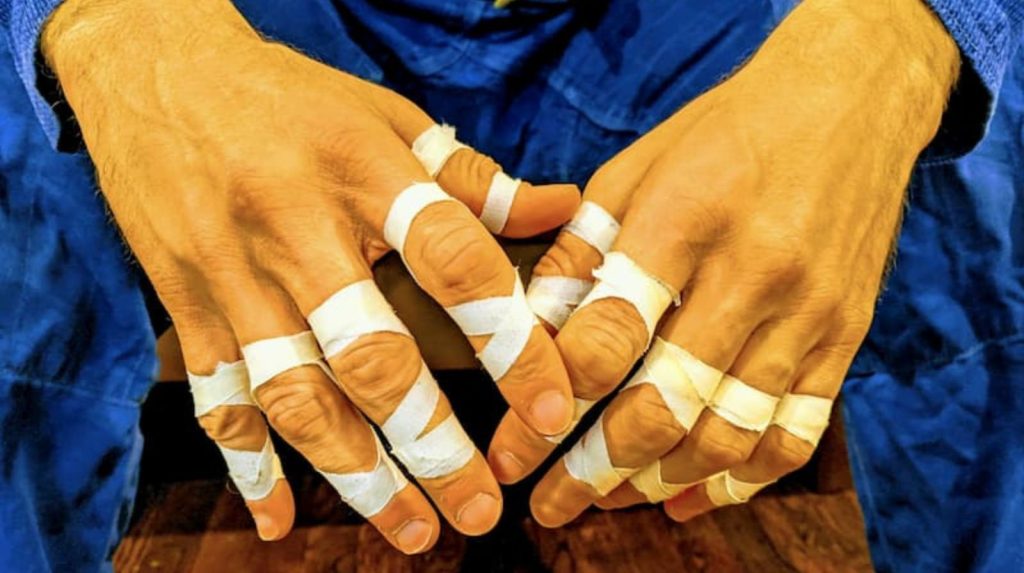
The hands and wrists work overtime in Brazilian jiu-jitsu, especially in the gi where gripping is constant. No-gi grapplers also strain the wrists through posting, framing, and clinching.
Regular hand and wrist stretches will help you improve resilience and manage discomfort from hard training weeks. Don’t neglect these—wrist injuries are preventable.
How to Use These Stretches: Timing & Protocol
The key to stretching success is NOT the stretches themselves—it’s when you do them. Science shows that stretching at the wrong time can reduce your strength and performance.
Before Training (5–10 minutes)
Use DYNAMIC stretches:
- Arm circles: 30 seconds
- Torso twists: 10-20 seconds
- Windmills: 10-20 seconds
- Leg swings: 10-20 seconds
- Walking lunges: 10-20 seconds
- Bear crawls, gorillas, alligators: 10-20 meters each
After Training (15–20 minutes)
Use STATIC stretches (hold 20-30 seconds):
- Hip stretches: 90/90, hip CARs, crossover glute
- Hamstring stretches: lying or sitting
- Upper body: overhead shoulders, child’s pose, thread the needle
- Full body: pretzel stretch
Rest Days (15–30 minutes)
Do a longer mobility session combining:
- All static stretches listed above
- Yoga for BJJ style routines (see resources below)
- PNF stretching (advanced: contract-relax techniques)
- Foam rolling if needed (5-10 minutes)
Modern Stretching Science: Static stretching before training can reduce strength by 2-5%, but static stretching after training (when tissues are warm) significantly improves range of motion and reduces soreness. Dynamic stretching before; static stretching after.
Additional Resources
- Yoga for BJJ: App-based program by Sebastian Brosche (IBJJF double gold medalist) featuring 10-minute daily routines with 50% improvement in 90 days
- 7-Minute Hip Mobility Routine: YouTube – Perfect Hip Mobility in 7 Minutes
- Post-Training Stretching Routine: Breathe and Flow – Complete Stretching Sequence
Final Thoughts: Your Long-Term BJJ Career Depends on This
As a Brazilian jiu-jitsu practitioner, your body moves in ways most people never experience. You invert, twist, frame, and apply pressure from unusual angles. Without a structured mobility and stretching routine, these demands quickly catch up with you.
A good routine will prepare your body for these “unusual” positions and help prevent common injuries. Flexibility and mobility for BJJ are not about doing splits—they’re about moving smoothly, accessing positions safely, and training consistently for years.
Your Simple 2025 Stretching Routine
⏱️ After Every Training Session (15-20 minutes)
Pick 5-6 stretches and hold each for 20-30 seconds. Focus on areas that felt tight during rolling. Start with lunge hip flexor, 90/90 stretch, lying hamstring, crossover glute, and overhead shoulder.
📅 On Rest Days (20-30 minutes)
Do your full stretching routine or follow a Yoga for BJJ session. This is when you make the most flexibility gains.
🎯 Monthly Progress Check
Test your flexibility: Can you reach your toes in a forward fold? Can you get deeper into your 90/90 stretch? Small wins compound into major improvements.
With a bit of consistency, you’ll notice that techniques feel smoother, injuries show up less often, and your body recovers faster between sessions.
We hope this updated Brazilian jiu-jitsu stretching guide helps you improve your flexibility and mobility so you can perform your favorite techniques and submissions more efficiently and enjoy a longer, healthier training career.
Your grappling longevity starts with taking care of your body. Make stretching non-negotiable.
Ready to Train Smarter for the Long Haul?
Get your FREE BJJ Longevity Checklist—a proven guide that reveals the training mistakes causing burnout and the simple habits that keep grapplers on the mats for decades.
Stop guessing. Start training smart. Your hips, knees, and long-term grappling career will thank you.
📋 Get Your FREE Checklist NowFrequently Asked Questions
Does BJJ Increase Flexibility on Its Own?
BJJ itself builds a certain level of “functional flexibility” because many positions open up your hips and legs, especially guard positions. However, if your goal is to play advanced guards (rubber guard, high guard, deep lasso, etc.), a dedicated stretching and mobility routine becomes almost mandatory.
Combining BJJ training with a structured post-class stretching routine is the fastest, safest way to improve flexibility.
What’s the Best Time to Stretch?
AFTER training is when static stretching is most effective and safe. Your muscles are warm, your nervous system is ready to relax, and you can achieve deeper stretches without losing strength. Avoid long static stretching immediately before training—it can reduce power and performance by 2-5%.
How Long Should I Hold Each Stretch?
20-30 seconds is optimal for post-training static stretching. Hold each stretch with steady, comfortable tension—never force into pain. Breathing deeply helps your nervous system relax and allows you to go deeper.
Can Tight Hips Cause BJJ Injuries?
Absolutely. Tight hips limit your range of motion, force compensations in other joints, and increase injury risk to your knees, lower back, and ankles. Hip mobility work is injury prevention, not optional.
What’s the Difference Between Stretching and Mobility?
Stretching is passive range of motion (hold and relax). Mobility is active range of motion with control. Hip CARs are mobility work; the 90/90 stretch is flexibility work. You need both.
Should I Stretch Before Rolling?
No static stretching before rolling. Use 5-10 minutes of dynamic warm-up (leg swings, arm circles, bodyweight movements) instead. Save static stretching for after class when your muscles are warm and loose.