Essential BJJ White Belt Techniques: The Ultimate Arsenal!
Stop getting overwhelmed. This is the definitive list of movements, escapes, submissions, and passes that you ACTUALLY need to know in your first year.
Starting Brazilian Jiu-Jitsu is like trying to learn a new language while drowning. There are thousands of techniques, endless variations, and confusing terminology.
But here is the secret: You don’t need to know everything.
The best white belts focus on a small, curated “arsenal” of high-percentage moves. They drill these until they are automatic. This guide expands the basics into a complete survival system for your first 12 months.
The 80/20 Rule
These core techniques account for over 80% of all successful exchanges at the white and blue belt levels.
1. The 5 Essential Movements
Technique starts with movement. If you can’t move your hips, you can’t fight.
The Shrimp (Hip Escape)
The #1 movement in BJJ. It creates space when you are pinned. Key Detail: Don’t just push with your arms; move your butt away to create a gap.
The Bridge (Upa)
Explosive hip extension. Used to off-balance opponents from mount or escape side control. Key Detail: Bridge onto your shoulder, not your flat back.
Technical Stand-Up
The safe way to return to standing. Protects your face from kicks and prevents you from being tackled.
Forward/Backward Rolls
Essential for preventing neck injury when you get swept or thrown. Learn to roll over your shoulder, never your head.
The Granby Roll
An advanced-beginner move for retaining guard. It involves spinning upside down across your shoulders to prevent a guard pass.
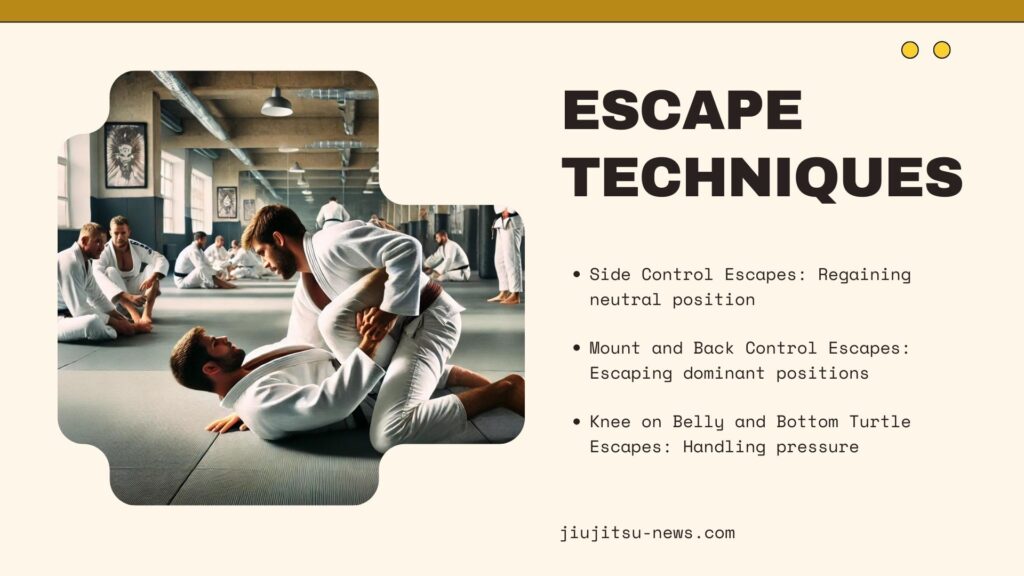
2. The Survival System (Escapes)
Your first 6 months is about surviving. If you can’t escape, you can’t play.
Side Control: The Frame & Recover
The most common bad spot. Use your forearms to create “frames” against their neck and hip. Bridge to create a gap, then shrimp your hips away to slide your knee back inside (Reguard).
Mount: Trap and Roll (Upa)
When they commit their weight forward or post an arm, trap that arm and the foot on the same side. Bridge explosively toward the trapped side to roll them over.
Back Mount: Protecting the Neck
The most dangerous position. Protect your neck first. Fight the choking hand (not the non-choking hand). Scrape your back against the mat to clear their hooks and turn into their guard.
Headlock Escape (Self-Defense)
The “schoolyard headlock” happens often. Don’t panic. Frame on their neck to prevent the choke, hook their leg with yours, and roll them over your body.
3. The 6 Foundation Submissions
Build your offense around these proven finishers.
| Submission | Type | Why It Works |
|---|---|---|
| Rear Naked Choke | Blood Choke | Highest percentage finish in MMA & Grappling. No Gi required. |
| Triangle Choke | Choke | Powerful from bottom guard. Uses your legs (stronger) vs their neck (weaker). |
| Armbar | Joint Lock | The classic. Hyperextends the elbow. Teaches you how to control a limb. |
| Kimura | Shoulder Lock | Versatile double-threat. Can be used to submit OR sweep an opponent. |
| Cross Collar Choke | Gi Choke | The fundamental Gi attack. Uses their own clothes against them. |
| Guillotine | Choke | The “punisher” move. Capitalizes on bad shots or opponents leaving their neck exposed. |
4. The Passing Game
Passing means getting past their legs to a dominant pin.
- Knee Cut (Slice): Speed-based. Slice your knee diagonally across their thigh.
- Toreando (Bullfighter): Agility-based. Grip the pants, throw the legs by, and pass around the outside.
- Over-Under Pass: Pressure-based. Shoulder in their stomach, one arm over, one arm under. Crush your way through.
- Double Under (Stack) Pass: Counter-based. When they open their guard, cup both hips, lift them up, and stack their weight onto their neck.
5. Fundamental Sweeps
Turn the tables. Go from bottom to top.
- Scissor Sweep: Uses a “knee shield” to chop them over. Best when they are upright.
- Hip Bump Sweep: Best when they posture up tall. Sit up and knock them over.
- Pendulum/Flower Sweep: A combo attack. If they defend the armbar, you swing your leg to sweep them.
- Tripod Sweep: The foundation of open guard. Hook the ankle, push the hip, and topple them backwards.
6. Takedowns & Standing
The fight starts on the feet. Do not ignore this phase.
The Single Leg
The safest takedown for beginners. Snatch one of their legs, keep your head on the inside (to avoid guillotines), and drive them down.
The Guard Pull
If you aren’t a wrestler, learn to pull guard safely. Grip the collar and sleeve, put one foot on their hip, and sit back while pulling them into your legs. Do not just flop to your butt without a grip!
7. Critical Mistakes to Avoid
The “Spazz” Phase
What is it? Moving 100mph with no technique, elbowing your partner, and flailing wildly.
Why it’s bad: You will hurt your training partners, and they won’t want to roll with you. Slow down. Focus on breathing.
- Holding Your Breath: If your face is purple, you’re doing it wrong. Breathe.
- Ego Tapping: Refusing to tap out because of pride leads to broken arms and long layoffs. Tap early, tap often.
- “Bench Pressing” Escapes: Trying to push a heavy opponent off your chest with just your arms. It never works. Use your frames (bone structure) and hips.
Final Word
This arsenal is your roadmap for the first year. Don’t try to learn all 25 moves this week. Pick one from each category (one escape, one pass, one sweep) and drill it for a month. Consistency wins.
The Ultimate BJJ Training Checklist for Beginners
The Ultimate BJJ Training Checklist for Beginners (2.0 Edition) is a complete, step-by-step system designed specifically for white belts who want sustainable progress—without burnout, confusion, or injuries.
This expanded 2.0 Edition includes 304 actionable checklist items across 15 essential sections, covering technique fundamentals, training habits, rolling strategy, mental game, strength & conditioning, nutrition, recovery, safety, and long-term progression.
Instead of vague advice, this guide tells you exactly what to focus on, when to focus on it, and why it matters during the most important phase of your BJJ journey.
Grab Your Free Copy Now!